
If you run a small business or an LLC, you have probably asked yourself this question at least once, usually right after an evening lost to bank statements: how much does a bookkeeper actually cost?
The honest answer depends on how you hire. A full-time employee, a part-time employee, a freelancer and an outsourced bookkeeping service are priced in completely different ways. This guide breaks down each option with real numbers, explains what pushes the price up or down, and helps you figure out which one fits your business.
The short answer
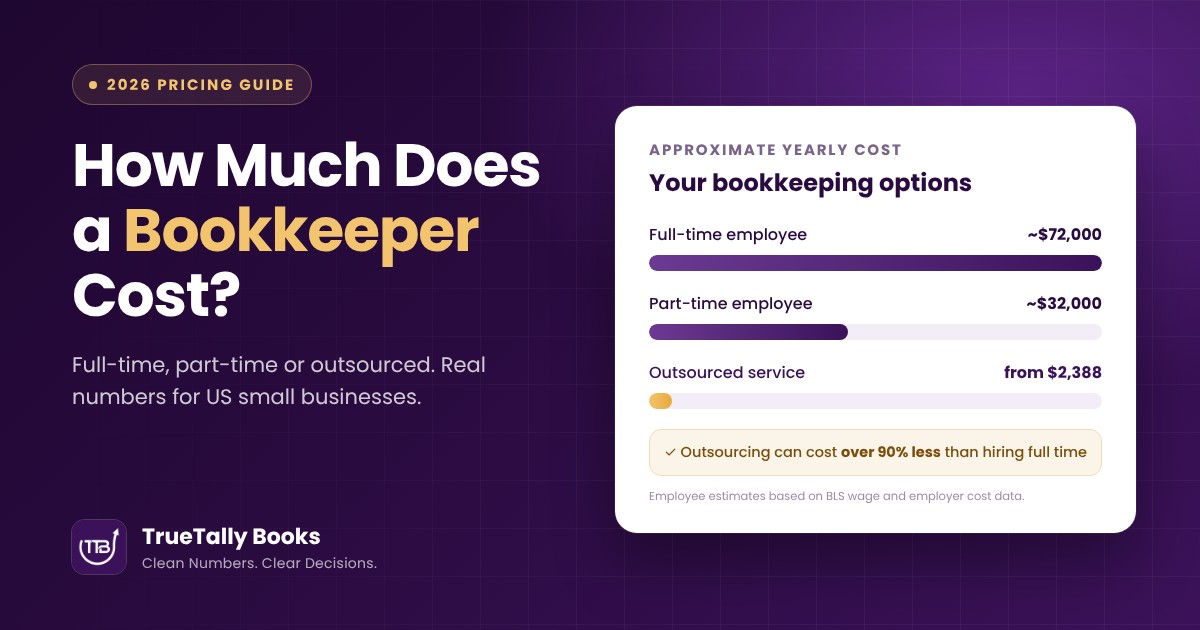
- Full-time in-house bookkeeper: roughly $72,000 a year once benefits are included.
- Part-time in-house bookkeeper (20 hours a week): roughly $32,000 a year.
- Outsourced monthly bookkeeping: a fixed fee, usually a few hundred dollars a month for most small businesses. Our own plans run from $199 to $549 a month.
- Doing it yourself: no invoice, but it costs your time, and mistakes can cost more later.
Most small businesses do not need a full-time bookkeeper. If you have fewer than a few hundred transactions a month, an outsourced service is usually the most cost-effective option. Here is why.
Option 1: Hiring a full-time bookkeeper
According to the U.S. Bureau of Labor Statistics, the median annual wage for bookkeeping, accounting and auditing clerks was $50,670 in May 2025, or about $24.36 an hour. Half of bookkeepers earn more than that, and wages run higher in expensive metro areas.
Salary is only part of the cost. BLS data on employer costs shows that in private industry, wages make up about 70 percent of what an employer spends on a worker, and benefits make up the other 30 percent (June 2026). That covers things like paid leave, health insurance, retirement contributions and payroll taxes.
Applying that ratio to the median wage gives a fully loaded cost of roughly $72,000 a year, or about $35 an hour, before you add software licenses, a computer, training and the time it takes to recruit and manage the person.
Makes sense when: you have high transaction volume, several entities, inventory, or you need someone on site every day.
Option 2: Hiring a part-time bookkeeper
A part-time employee working 20 hours a week at the median wage earns about $25,300 a year. Part-time workers usually receive fewer benefits. BLS data shows benefits make up about 20 percent of employer costs for part-time private industry workers, which puts the total at roughly $32,000 a year.
That is cheaper than full time, but you are still an employer. You handle payroll, cover vacations, and start over if the person leaves. Many small businesses also find that 20 hours a week is more time than their books actually need.
Option 3: Hiring a freelance bookkeeper by the hour
Freelancers and independent firms usually bill well above the employee wage, because their rate has to cover their own software, insurance, overhead and unbilled time. Hourly billing can work for a one-time project, but for ongoing work it has a drawback: you pay for time, not results, and the bill changes every month.
If you go this route, ask for an estimate of hours before work starts and a cap on monthly hours.
Option 4: Outsourced monthly bookkeeping
This is the most common setup for small businesses today. You pay a fixed monthly fee, and a bookkeeping team categorizes transactions, reconciles your bank and credit card accounts, and sends you financial reports every month. Pricing is usually based on how many transactions and accounts you have.
As an example, here is how our own plans work:
| Plan | Monthly transactions | Bank and card accounts | Price |
|---|---|---|---|
| Starter | Up to 100 | Up to 2 | $199/month ($2,388/year) |
| Growth | Up to 300 | Up to 5 | $349/month ($4,188/year) |
| Pro | Up to 700 | Up to 10 | $549/month ($6,588/year) |
Even the Pro plan costs less than a tenth of a full-time bookkeeper’s fully loaded salary. You also skip payroll, benefits, recruiting and turnover.
Makes sense when: you want accurate books every month at a predictable price, and you do not need someone physically in your office.
Side-by-side comparison
| Option | Approximate yearly cost | Best for |
|---|---|---|
| Full-time employee | ~$72,000 | High volume, complex operations |
| Part-time employee | ~$32,000 | Steady work that needs someone in-house |
| Freelancer (hourly) | Varies month to month | One-time projects |
| Outsourced monthly service | ~$2,400 to $6,600 | Most small businesses and LLCs |
| Do it yourself | Your time | Very new businesses with few transactions |
Employee figures are estimates based on BLS median wage and employer cost data. Actual costs vary by location and experience.
What affects the price of bookkeeping
- Transaction volume. More transactions means more categorizing and reconciling.
- Number of accounts. Every bank account, credit card and payment platform (such as Stripe, PayPal or Square) has to be reconciled.
- How far behind you are. If your books have not been touched in months, they need a cleanup before monthly work can start. Cleanup is usually priced per month of history.
- Extra complexity. Inventory, multiple entities, payroll, or sales across several states all add work.
- Software. Your QuickBooks Online, Xero or Zoho Books subscription is usually billed to you separately by the provider.
The hidden cost of doing it yourself
DIY bookkeeping feels free, but try this quick math: multiply the hours you spend on your books each month by what an hour of your time is worth to your business. If you spend six hours a month and your time is worth $75 an hour, that is $450 a month, more than our Starter or Growth plan.
There is also the cost of mistakes: miscategorized expenses, missed deductions your CPA cannot see, unreconciled accounts, and a scramble every tax season. Clean books make your CPA’s job faster, which can lower your tax preparation bill too.
Bookkeeper vs. CPA: who does what
A bookkeeper records and organizes your financial transactions every month and keeps your books accurate. A CPA or tax preparer uses those books to file your tax returns and give tax advice. Most small businesses need both, and they work best together. A good bookkeeper hands your CPA clean, reconciled books at year-end.
At TrueTally Books, we focus on bookkeeping only. We keep your books tax-ready and work alongside your CPA or tax preparer.
How to choose the right option
- Count your monthly transactions. Look at last month’s bank and card statements.
- List your accounts. Banks, credit cards, loans and payment platforms.
- Check how current your books are. Are all months reconciled?
- Ask for a fixed quote. A good provider gives you a clear monthly price before any work starts.
Frequently asked questions
How much should a small business pay for bookkeeping per month?
For an outsourced service, most small businesses pay a few hundred dollars a month, depending on transaction volume and the number of accounts. Our plans start at $199 a month for up to 100 transactions.
Is it cheaper to hire a bookkeeper or use a service?
For most small businesses, a service is cheaper. A full-time employee costs roughly $72,000 a year with benefits, while outsourced monthly bookkeeping typically costs a few thousand dollars a year.
How much does catch-up bookkeeping cost?
Catch-up or cleanup work is usually priced per month of history, based on how many transactions there are and how messy the records are. Ours starts at $150 per month of history, with a fixed quote after we review your books.
Does a bookkeeper file my taxes?
Not usually. Bookkeepers keep your records accurate and organized. A CPA or tax preparer files your returns. We prepare tax-ready books and work alongside your tax professional.
Can an online bookkeeper work with QuickBooks Online?
Yes. QuickBooks Online is cloud-based, so you add your bookkeeper as a user or accountant, and you can remove that access at any time. We also work with Xero and Zoho Books.
Get a fixed quote for your books
Not sure which plan fits? Send us a message with your monthly transaction count and the software you use, and we will reply with a fixed quote within one business day. You can also compare our plans or see everything we do.